Temple height
The proposed temple points should remain appropriate for the patient’s age, forehead proportions and long-term hair-loss pattern.

Temple and frontal-corner restoration
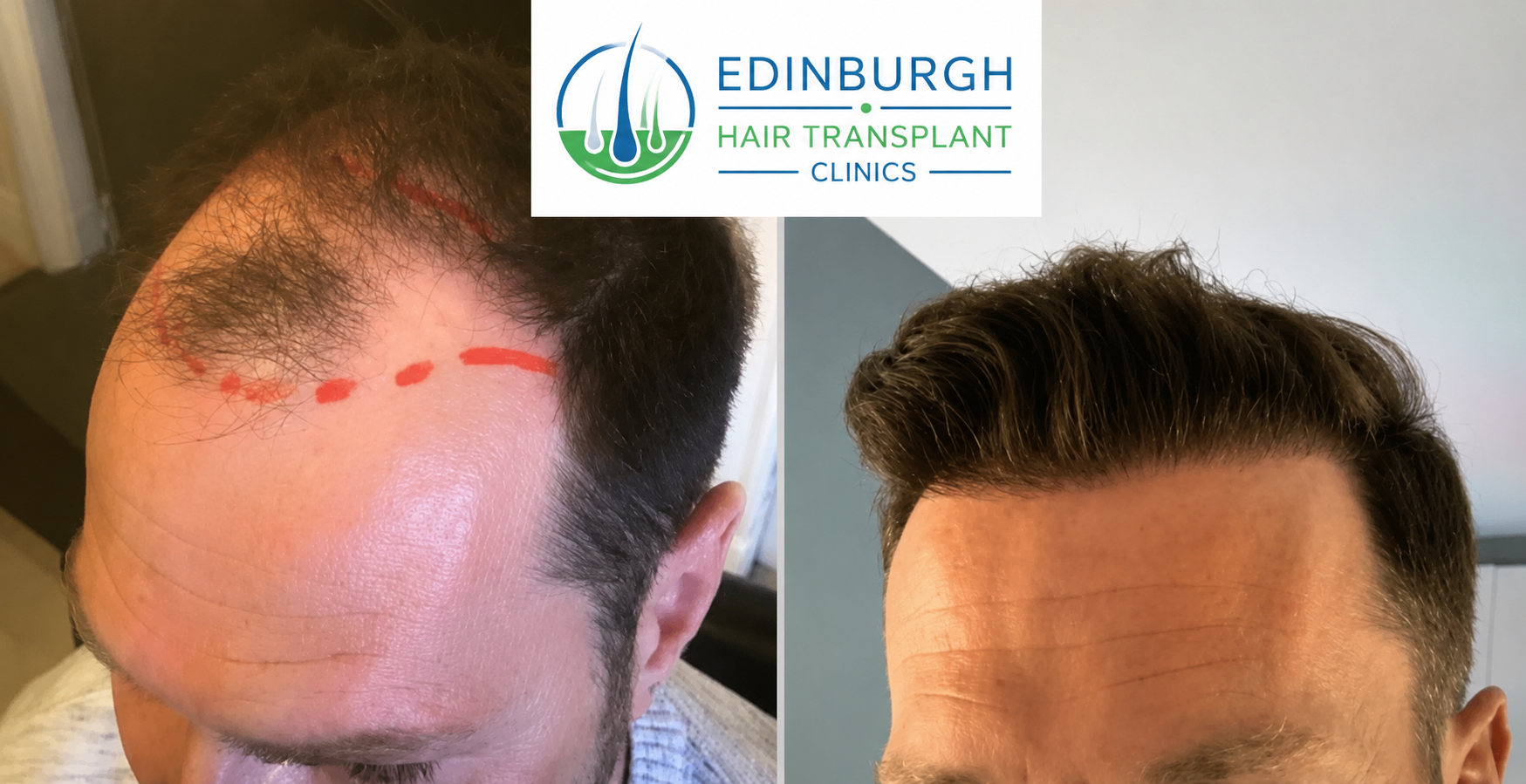
A temple hair transplant can restore recession around the sides of the frontal hairline and improve the way the hairline frames the face.
Edinburgh Hair Transplant Clinics provides consultation-led planning covering temple-point design, donor-area suitability, graft requirements, FUE hair transplantation, DHI, costs, recovery and realistic expectations.
Natural temple-point design
Temple transplantation is not simply a matter of filling an empty area. The shape, angle and direction of the new temple points must blend with the existing frontal hairline and facial proportions.
The proposed temple points should remain appropriate for the patient’s age, forehead proportions and long-term hair-loss pattern.
Single-hair grafts and controlled irregularity may help avoid an unnaturally sharp or artificial edge.
Temple hairs normally emerge at a shallow angle and should lie close to the skin rather than point outward.
Graft direction should follow the natural flow of neighbouring hairs and change gradually across the treatment area.
The two sides should appear balanced without creating a perfectly mirrored or unnaturally rigid design.
The design should remain credible if the untreated frontal or mid-scalp hair continues to thin over time.
Treatment stages
Your temple recession, hair-loss history, medical information, treatment goals and donor supply are reviewed.
The proposed height, shape, angle and connection with the frontal hairline are discussed.
Graft requirements are estimated according to the size of the temple recession and density objectives.
Suitable follicular units are selected and extracted from the agreed donor area.
Recipient sites are created to control the direction, spacing and shallow angle of the transplanted hairs.
Grafts are distributed to produce a softer edge and gradual transition into the existing hairline.
Patient suitability
Treatment methods
| Method | How it may be used | Important consideration |
|---|---|---|
| FUE | Individual follicular units are extracted and placed into carefully planned sites around the temples and frontal corners. | Single-hair selection, shallow angles and conservative donor extraction are particularly important. |
| DHI | Individual extraction may be combined with implanter-device placement for selected temple treatment plans. | DHI is not automatically the best method for every patient; suitability depends on the individual design and graft plan. |
| FUT | Follicular-unit grafts are prepared from a strip of donor tissue and can be placed into temple recipient sites. | FUT creates a linear donor scar and is considered only for selected treatment plans. |
Temple transplant pricing
A meaningful quotation should follow assessment of the donor area, temple design and likely graft requirement.
Healing and growth
Temporary redness, swelling, tenderness and crusting may occur around the donor and temple areas.
Transplanted hairs may shed during the early weeks before new growth begins gradually.
New temple growth may initially appear fine or uneven before the hairs mature and become easier to style.
Surgeon-led assessment
Ask how the temple height, shape, angle and graft distribution have been selected and whether the design will remain appropriate as you age.
Patient feedback
Read patient feedback about consultation, communication, treatment-day organisation, recovery support and aftercare.
Edinburgh clinic location
83 Princes St
Edinburgh
EH2 2ER
Contact the clinic before travelling to confirm your consultation time and appointment arrangements.
Telephone:
0131 639 0004
Common temple-transplant questions
A temple hair transplant moves suitable donor-hair grafts into the temple points, frontal corners or surrounding hairline to improve recession and facial framing.
Temple recession may be restored in selected patients, depending on donor supply, hair-loss pattern, age, hair characteristics and realistic design planning.
FUE may be suitable for selected patients. Temple work requires careful single-hair selection and placement at the correct angle, direction and density.
DHI may be discussed when implanter-device placement is considered appropriate for the treatment area, hair type and graft plan.
Graft requirements depend on the size of the temple recession, whether the frontal corners are treated, donor-area quality and the proposed density.
Cost depends on the treatment area, graft requirements, donor suitability, chosen method and whether the frontal hairline is also included.
A natural-looking result depends on design, graft selection, hair angle, direction, density, donor quality, healing and growth. Results vary.
No. Graft survival, growth, density, healing and final appearance vary between patients.
Request an assessment
Contact Edinburgh Hair Transplant Clinics to discuss temple-point design, frontal-corner recession, donor-area suitability, FUE, DHI, graft requirements, costs, recovery and aftercare.
