FUT donor scars
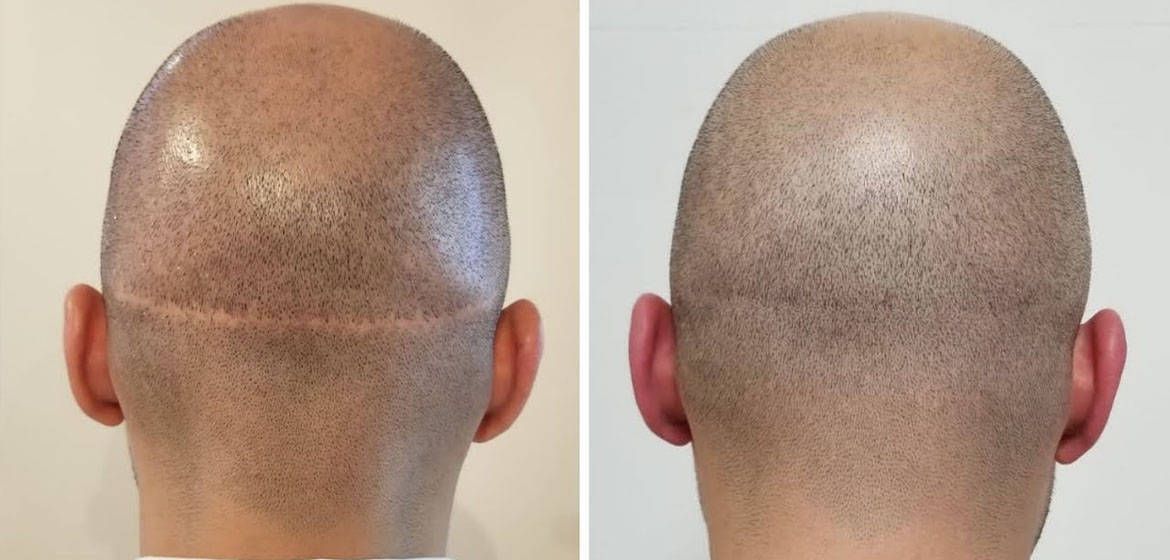
FUE grafts may sometimes be placed into or around a visible linear scar left by previous strip hair-transplant surgery.
Hair restoration for selected stable scars
A scar hair transplant places suitable donor-hair grafts into or around selected stable scar tissue to help reduce its visibility.
Edinburgh Hair Transplant Clinics provides consultation-led assessment for selected surgical, injury, burn and previous hair-transplant scars using FUE hair transplantation or another appropriate method.
Selected scar-repair cases
Suitability depends on the individual scar rather than its name alone. The scar should be assessed for healing, stability, blood supply, thickness, inflammation and the likelihood that transplanted grafts can grow successfully.
FUE grafts may sometimes be placed into or around a visible linear scar left by previous strip hair-transplant surgery.
Selected patchy or overharvested donor areas may be assessed, although available donor supply can limit treatment.
Stable scars following surgery may be considered where the surrounding hair and donor area can support camouflage.
Scars caused by injury may be assessed once the tissue has fully healed and no further reconstructive treatment is planned.
Selected stable burn scars may be considered, but tissue quality and blood supply can vary considerably.
Selected stable scars affecting the beard, moustache or eyebrow region may also be assessed for hair restoration.
Treatment stages
The scar’s cause, age, size, texture, colour, symptoms, healing history and previous treatments are reviewed.
The clinic assesses whether there is active inflammation, infection, scarring alopecia or a history of abnormal scar formation.
Donor density, hair calibre, safe extraction capacity and the effect of any previous surgery are examined.
Graft spacing may need to be more conservative than in normal scalp tissue because scar blood supply can be reduced.
Suitable follicular units are placed at planned angles and directions to blend with the surrounding hair.
Healing and growth are monitored over time. Some patients may require staged treatment or an additional session.
Treatment suitability
Treatment methods
| Method | How it may be used | Important consideration |
|---|---|---|
| FUE | Individual donor follicles are extracted and placed into or around the selected scar. | FUE is commonly discussed because graft numbers and placement can be controlled without creating another linear donor scar. |
| DHI | FUE-style extraction may be combined with implanter-device placement in selected treatment plans. | Scar quality and blood supply remain important regardless of the implantation tool used. |
| FUT | A strip of donor scalp is removed and divided into follicular-unit grafts. | FUT creates a new linear donor scar and is therefore considered carefully in scar-repair cases. |
Individual quotation
Scar hair transplant pricing depends on the size and location of the scar, tissue complexity, likely graft requirement, donor quality and whether staged treatment is recommended.
Clear photographs can help with an initial enquiry, but the scar and donor area may need to be examined directly before treatment and pricing are confirmed.
Healing and growth
Temporary redness, swelling, tenderness, small scabs and donor-area sensitivity may occur after treatment.
Transplanted hairs may shed during the early recovery period before gradual new growth begins.
Coverage develops as transplanted hairs grow and mature. Scar colour and texture may still remain visible.
Consultation-led planning
Further clinical reading
Review general surgical risks, expected scarring, recovery and questions to ask before cosmetic hair-transplant surgery.
Read NHS GuidancePublished clinical research discusses the additional difficulty created by reduced circulation and tissue stiffness.
View PubMed StudyA published study evaluated follicular-unit transplantation for stable postsurgical scalp scar camouflage.
View Clinical ResearchPatient feedback
Edinburgh clinic location
83 Princes St
Edinburgh
EH2 2ER
Contact the clinic before travelling to confirm your consultation and appointment arrangements.
Telephone:
0131 639 0004
Common scar-repair questions
Selected stable scars may support transplanted hair, but suitability depends on scar quality, blood supply, thickness, healing history and donor-hair availability.
No. Hair transplantation does not remove scar tissue. The purpose is to help camouflage the scar by growing hair through or around it.
FUE grafts may sometimes be placed into or around a stable linear FUT scar. Suitability depends on the scar tissue and available donor supply.
Selected patchy donor areas may be assessed, but repair can be limited because the remaining donor supply may already be reduced.
Selected fully healed and stable burn or trauma scars may be considered after assessment of tissue quality and blood supply.
Hair transplantation may be considered only in selected cases where the underlying inflammatory condition has been medically assessed and appears inactive.
No result can be guaranteed. Graft survival may be less predictable in scar tissue because its circulation and structure can differ from healthy scalp.
Yes. Conservative density, variable graft growth or a large scar may mean staged treatment or another session is considered.
Cost depends on the scar’s size, location and complexity, estimated graft numbers, donor quality and whether staged treatment is recommended.
Request an assessment
Contact Edinburgh Hair Transplant Clinics to discuss the scar’s history, stability, location and appearance, along with donor suitability, FUE planning, costs and realistic expectations.
