Before | After
Case study
Case study
2,300 grafts
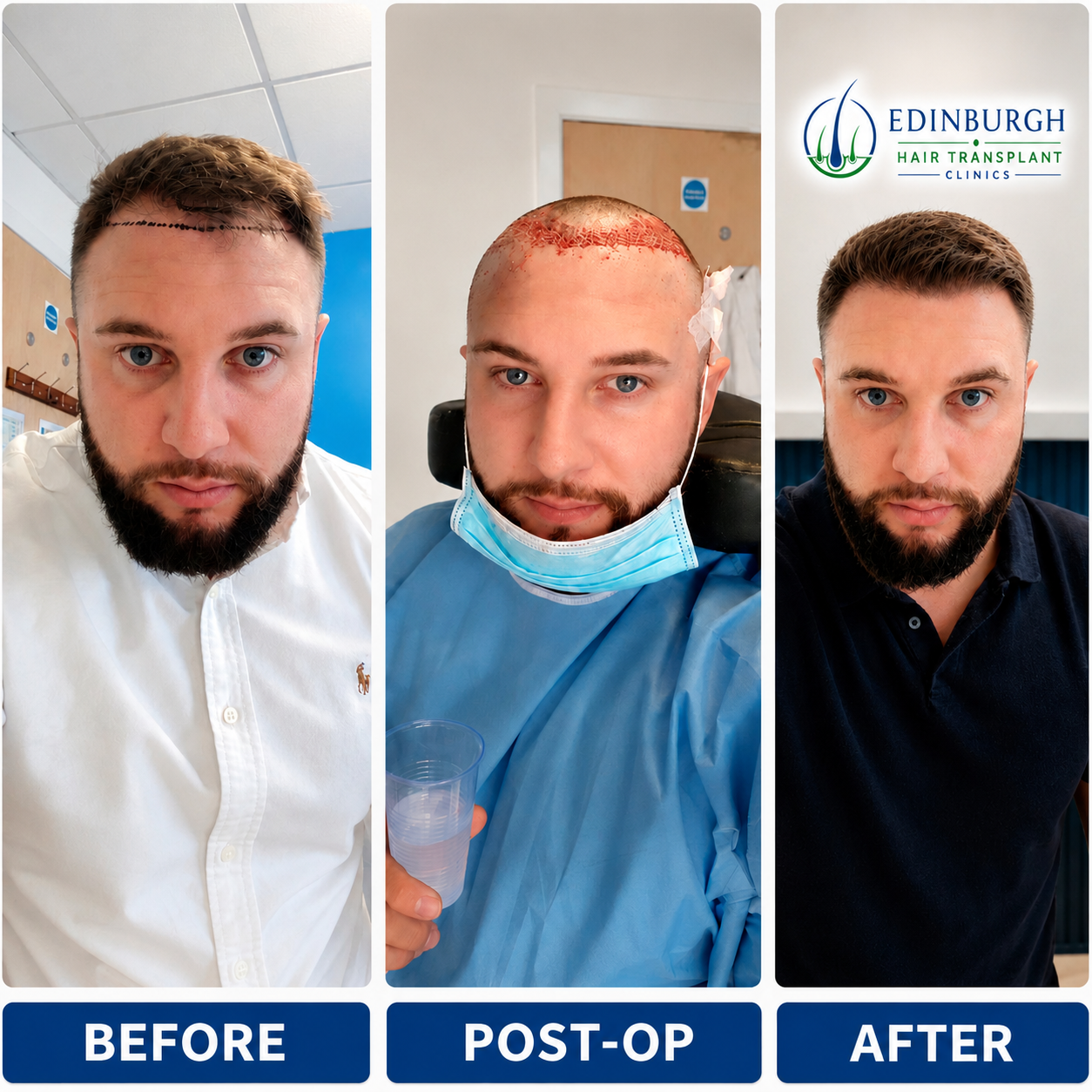
A widow’s peak is the V-shaped point in the centre of the frontal hairline. Some people have always had one. In others, it becomes more noticeable as the corners on either side begin to recede.
A widow’s peak transplant does not remove that central point. It adds donor follicles around it to soften a pronounced V-shape, fill recessed corners or rebuild more of the frontal hairline. The shape is planned around the patient’s face, the direction of the existing hair and the way their hair loss is likely to progress.
Before recommending treatment, Dr Harpreet Kalra establishes whether the patient has a stable natural peak, a receding hairline or both.
Book a Free ConsultationCertifications


A widow’s peak is the point of hair that extends downwards in the middle of the frontal hairline. It may form a shallow curve or a much sharper V across the forehead. The point itself is not baldness and does not need treating simply because it is there.
What matters is the hairline around it. A central point can look balanced when the surrounding hair is dense and stable. It looks much sharper if the frontal corners have moved backwards, the temples are thinning or the hair immediately behind the edge has lost density. The consultation therefore looks at the whole frontal third of the scalp, not just the centre.
Surgery changes the outline around the peak by placing follicles beside it and, where needed, slightly in front. This can soften a narrow point, balance an uneven frontal line and reconnect recessed corners with the hair above the ears. It does not remove the existing peak.
For one patient, the treatment area may be limited to two small sections beside a stable central point. For another, it may include both corners, the frontal edge and the central forelock. A wider reconstruction uses more grafts and places greater demands on the donor area.
Some patients want to keep the central point but make it less prominent. Others want a flatter line with only a shallow curve at the centre. There is no standard shape that suits everyone. Forehead height, facial width, age, hairstyle, existing temple points and available donor hair all affect the final design.
Old photographs are often the clearest way to tell the difference. With a long-standing widow’s peak, the central point and the corners stay in roughly the same position over the years, even when the forehead has always been relatively high.
A receding hairline does not stay in the same place. The corners move backwards and leave a deeper M-shape around the central forelock. One side may change faster than the other, and the hair behind the visible edge can become finer before any bare skin appears.
The distinction changes the operation. A stable peak can sometimes be adjusted with a focused hairline procedure. If the corners are still receding, the new line has to allow for further loss behind and beside the grafts. Setting it too low can leave the transplanted edge isolated from the patient’s own hair later.
During the assessment, older photographs are compared with the current hairline. The doctor checks the front and temples for miniaturised hairs, then examines the donor region for density, hair calibre and any signs of thinning. Age, family history and the speed of recent change are considered at the same time.
If pattern hair loss is active, the long-term plan may include medical treatment alongside surgery. The transplant reshapes the hairline. Medication has the separate job of supporting the patient’s remaining native hair.
Edinburgh Hair Transplant Clinics
A widow’s peak transplant is first and foremost a hairline-design procedure. People will see the result from the front and at normal conversational distance, which makes mistakes in height, direction or graft choice difficult to disguise.
The first decision is how much of the central point to retain. Hiding a strong peak beneath a low, straight line can waste grafts and produce a shape that does not suit the face. A shallow curve through the centre, combined with properly rebuilt corners, often looks more natural than a rigid horizontal edge.
The surgeon assesses the line in relation to the eyebrows, forehead height, facial width and existing temple points. The corners do not need to be mirror images of each other. Most faces are naturally asymmetrical, and forcing exact symmetry can make a hairline look artificial.
Scalp hair grows in follicular units containing one or more hairs. The finest single-hair grafts are kept for the visible edge. Placing thick, multi-hair grafts at the front can leave it looking coarse or plug-like. Two- and three-hair units sit behind that edge, where they add coverage without making the outline heavy.
Hair through the centre usually points forwards, then changes direction as it approaches each corner. The recipient sites need to follow that movement. Grafts placed at a single angle can fan out unnaturally and make the finished hairline difficult to style.
The full design is drawn and agreed with the patient sitting upright. Before local anaesthetic is given, it is checked from the front, from both sides and at three-quarter angles.
The final hairline is drawn with the patient sitting upright. At this stage, the surgeon checks the position of the central point, the depth of both corners and the way the new line will join the hair at the sides. The design is agreed before treatment begins.
The procedure is performed under local anaesthetic. Only the donor area being used is trimmed where necessary. Follicular units are then collected using the agreed FUE or FUT method and kept in a suitable holding solution while the frontal area is prepared.
Under magnification, the grafts are counted and sorted by the number and calibre of hairs they contain. Fine single-hair grafts are reserved for the visible edge. Stronger grafts are kept for the area behind it, where they provide coverage without making the front look heavy.
The surgeon creates the recipient sites before the grafts are inserted. These tiny openings establish the height, spacing, irregularity and changing direction of the new hairline. Once placement is complete, the donor and recipient areas are checked and the patient leaves with written aftercare instructions.
Edinburgh Hair Transplant Clinics
FUE, DHI and FUT describe different ways of collecting or placing grafts. The chosen method affects the donor area, the type of scarring and the way the operation is organised. It does not decide how natural the hairline will look. That depends on the design, the grafts selected for the visible edge and the control of their angle and direction.
Follicular units are removed individually with a small punch during an FUE hair transplant. This avoids a linear donor scar, although it leaves many small circular marks spread across the harvested area.
FUE is often used for focused frontal work because the surgeon can select individual follicular units and spread the extraction across the back and sides. Even so, the amount taken from each part of the donor area has to be controlled to avoid visible thinning.
Once the grafts have been collected, a specialist implanter can be used to insert them as part of the DHI method. The device helps with graft handling and placement. It does not design the widow’s peak or decide the direction in which the hair should grow; those remain surgical decisions.
A different harvesting option is the FUT hair transplant method. A narrow strip of donor scalp is removed and divided into individual follicular units. This leaves a linear donor scar, but it can supply a substantial number of grafts without trimming the surrounding donor hair.
The choice between these methods is made after reviewing the graft estimate, hairstyle, donor density, any previous scarring and the patient’s longer-term treatment plan.
There is no standard graft count for a widow’s peak transplant. Filling two small gaps beside a stable central point is a much smaller procedure than rebuilding both corners, the frontal edge and the central forelock.
The estimate depends on the size of the area being restored, the coverage needed behind the front edge, how much existing hair can be retained and the characteristics of the donor hair.
The four case studies on this page range from 1,800 to 3,500 grafts. The higher figures involve wider frontal restoration and should not be used to predict how many grafts another patient will need.
The cost can be confirmed once the surgeon has examined the donor area and agreed the hairline design. The quotation will cover the planned method, estimated graft count, treatment area and aftercare. Further details are available in the Edinburgh hair transplant cost guide and the clinic’s payment options.
Lowering the hairline creates a larger area to cover. Even a small reduction in forehead height can require considerably more grafts, so the planned change must be balanced against the donor hair that could be needed later.
Request a Graft AssessmentEdinburgh Hair Transplant Clinics
Suitability depends on why the patient wants treatment, whether the surrounding hair is stable and whether the donor area can support the proposed design. Grafts can be placed into the front of the scalp, but that does not make every possible hairline a sensible one.
Someone with a stable, long-standing V-shaped hairline may be suitable if the aim is to soften the peak or balance the frontal outline. Receded corners can also be restored, although the design must allow for native hair continuing to thin behind the transplant.
The donor area must have enough density and the right follicular units to build a soft edge without visibly depleting the back and sides. Coverage is also affected by hair calibre, curl, colour contrast and the number of hairs in each graft.
Rapid or unexplained shedding needs investigating before a cosmetic hairline is created. Surgery may also be unsuitable if there is active inflammatory or scarring scalp disease, an unstable donor area or expectations that the available hair cannot meet.
Extra care is needed when a younger patient’s corners are changing quickly. A low line designed for how the hair looks today can become unsuitable as the native hair recedes. In that situation, stabilisation, observation or medical treatment may be the better first step.
Widow’s peak work can also be included in a gender-affirming hairline procedure. The frontal contour, temple points and the relationship between the hairline and facial features are then planned as one design.
Donor hair is limited. Follicles used at the widow’s peak cannot later be moved to the crown, mid-scalp or another part of the frontal hairline. The first operation has to improve the current concern without using hair that may be needed in the future.
The permanent donor zone is checked for density, hair calibre, miniaturisation and previous scars. Grafts are taken across the area rather than concentrated in isolated patches. If the donor region is already weak, building a dense, low hairline could leave an obvious imbalance between the front and back of the scalp.
Transplanted follicles keep many of the characteristics of the area they came from. The native hair around them can still thin, however, leaving a gap between the transplanted front and the hair behind it. A conservative design and a long-term plan help to reduce this risk.
Redness, swelling, crusting, temporary numbness and tenderness are expected during early recovery. Possible surgical complications include bleeding, infection, a reaction to anaesthetic, poor graft growth, visible scarring, shock loss, asymmetry and hair growing in an unnatural direction.
Grafts can grow successfully and still produce a poor-looking result if the line is too low, too straight or too dense for the donor supply. The position and shape of the edge matter just as much as the number of surviving grafts.
No clinic can promise that every graft will grow or reproduce another patient’s result. The consultation should explain what the individual donor area can realistically achieve and what options would remain if more hair is lost later.
The scalp heals long before the transplanted follicles produce mature hair. The appearance immediately after surgery is not the finished result; the change needs to be judged over the following months.
The clinic’s aftercare instructions cover washing, sleeping position, exercise, headwear, sun exposure and when to ask for advice. More detail is available in the aftercare guide and recovery timeline.
Non-surgical treatments cannot move a stable widow’s peak or put follicles into bare skin. When the concern is purely the inherited shape of the hairline, a transplant is the treatment that can change its position and outline.
Medication is more relevant when the central point has become prominent because the surrounding native hair is thinning. Its purpose is to support susceptible follicles and slow further loss, not to create a new frontal edge. Whether it is suitable depends on the diagnosis, medical history, possible side effects and the patient’s willingness to continue treatment.
Platelet-rich plasma treatment is sometimes used where weakened follicles are still active. It does not rebuild empty frontal corners and is not a replacement for grafts in areas where no useful hair remains.
Hair fibres and a change of hairstyle can reduce the contrast created by thin corners. The effect is temporary, but it can be useful while the pattern of loss is being monitored.
Waiting is also an option. If the rate of recession is unclear, photographs taken in consistent lighting over several months can show whether the hairline is stable enough to plan permanently.
When surgery and medical treatment are used together, they do different jobs. The transplant changes the shape of the widow’s peak; ongoing treatment is intended to protect native hair outside the transplanted area.
Widow’s peak work leaves little room for error. The surgeon has to control the frontal shape, select the fine grafts needed at the visible edge and follow the direction of the patient’s existing hair.
At Edinburgh Hair Transplant Clinics, each patient is assessed by Dr Harpreet Kalra, a GMC-registered doctor, GMC 7126076. He examines the current hairline, the history of any recession, the condition of the scalp and the amount of permanent donor hair available.
The proposed line is checked from the front, both sides and at three-quarter angles. Dr Kalra looks at whether the central point remains balanced, how the corners join the side hair and whether the design would still make sense if the surrounding hair changed later.
The consultation also covers the graft estimate, harvesting method, likely recovery, limitations and confirmed treatment cost. These points are explained before the patient decides whether to go ahead.
Book a Consultation with Dr Kalra
No. A transplant adds follicles around the existing peak; it does not remove the hair that forms the point. Filling the areas beside it can soften the V-shape or produce a flatter frontal outline.
No. Many people have had a V-shaped point since childhood. When the corners recede, an existing peak can look sharper, which is why the whole pattern needs to be assessed.
It depends on the width and depth of the area being rebuilt. A small adjustment beside the peak and a full frontal restoration need very different graft numbers.
The line can be made flatter, but a rigid straight edge often looks unnatural. A believable design normally keeps some irregularity and follows the patient’s facial proportions and natural hair direction.
Neither method guarantees a better hairline. FUE describes how grafts are extracted, whereas DHI usually refers to placement with an implanter. The design, graft selection and direction still determine how natural the result looks.
Early growth often starts after three to four months. The outline becomes clearer during months five and six, and the hair continues maturing for approximately 12 to 18 months.
Yes. A transplant does not stop hair loss in untreated follicles. The design needs to allow for possible thinning behind and beside the grafts.
The price is confirmed after the design, donor area, graft estimate and method have been assessed. The patient should receive a quotation before deciding whether to proceed.
Edinburgh Hair Transplant Clinics
83 Princes St
Edinburgh, EH2 2ER
0131 639 0004

Choosing a hair transplant clinic is a personal decision. You want to know who will look after you, what happens on the day and who you can contact afterwards. We believe those conversations deserve as much care as the treatment itself. From your first enquiry through to your follow-up appointments, our team is here to answer questions and explain each step. Below, you can read the feedback and ratings patients have left for Edinburgh Hair Transplant Clinics.
Read our patient reviews on Google.
Please note I am writing this review based on the process not the result as Will not know the full extent of the result for a few months. The process of booking was great, Kevin was very helpful from the very beginning and was very quick at replying and very knowledgeable with any questions or queries I had. I felt well informed and prepared for the hair transplant. On the day itself, I was welcomed into the clinic and talked through the plan for the day. Throughout the procedure I was very well looked after and cared for. It went very smoothly and I was comfortable the full time once the local anesthetic was in I did not feel anything. Very thorough after care was provided along with everything I needed to take care of the transplanted hair initially so did not have to worry about purchasing anything, shampoo, spray bottle and pillow all included. Along with contact details incase required. So far I am amazed by the results, it already looks incredible. I have never felt so confident in photos and this is just the implanted hair, looking forward to seeing how it develops over the coming months. Be prepared for a couple of sleepness nights following the procedure but so worth it already! Highly recommend booking your hair transplant with this company. The support throughout is so valuable. They really care for you and working with you towards the result you are looking for. Will happily post an update to this review at the 6 month mark but do not hesitate to use this company, 5* and first class.


