
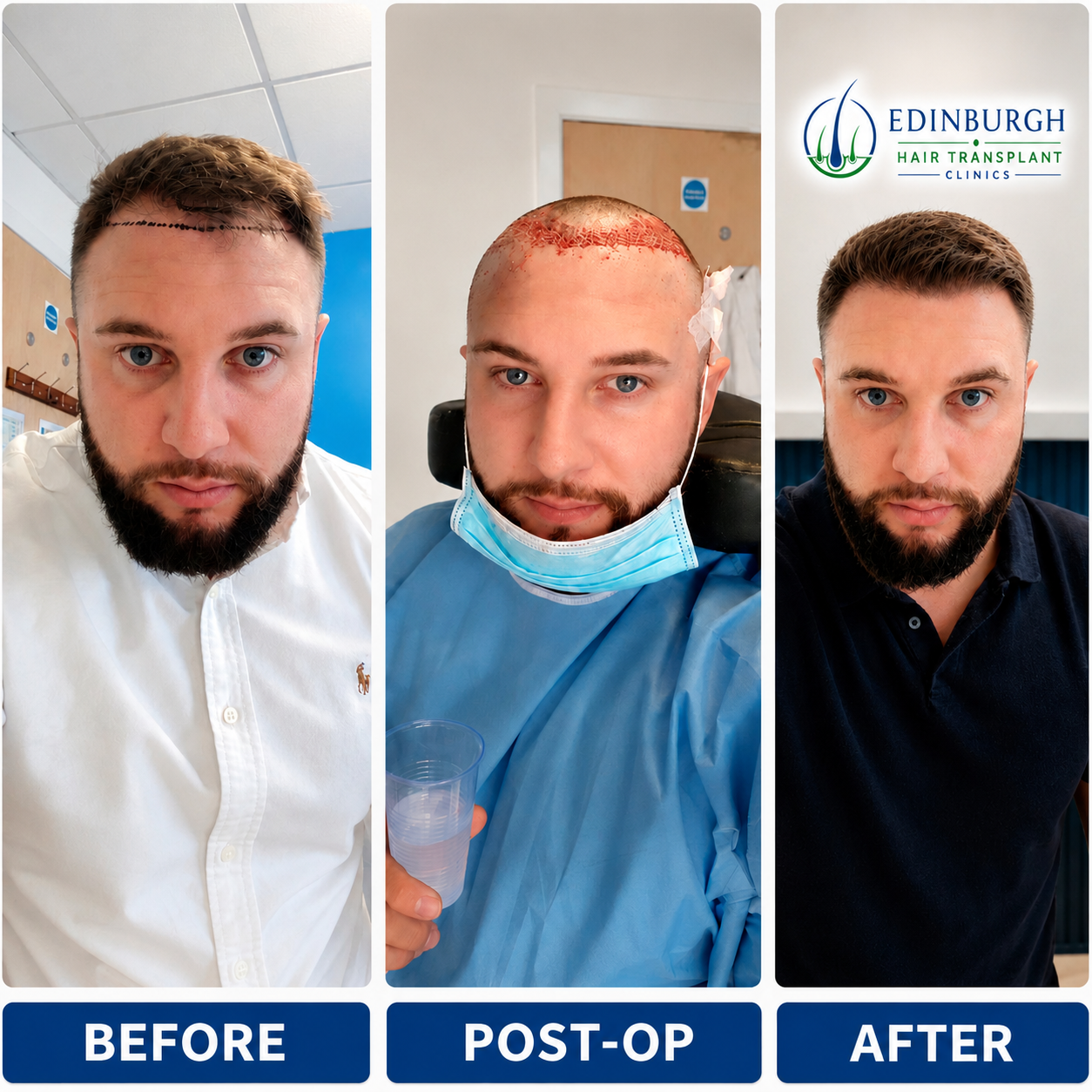
Hairline Transplant Edinburgh
Hairline restoration is one of the most visible forms of hair transplant surgery. Small differences in height, shape, density or direction can change the way the whole front of the scalp looks.
The aim is not simply to replace hair where recession has appeared. Dr Harpreet Kalra considers the patient's facial proportions, remaining native hair, temple recession and the amount of donor hair that may still be needed later when planning the new hairline.


Hairline Transplant in Edinburgh
A hairline transplant uses suitable follicles from the donor region to rebuild areas of recession across the front of the scalp. Treatment may involve the central hairline, the corners at either side, the temples or a wider area extending into the frontal scalp.
The hairline is different from most other transplant areas because it is immediately visible from the front. There is very little room for a design that is too straight, positioned too low or separated sharply from the existing hair behind it.
A naturally occurring hairline also does not begin at full density. The leading edge is usually softer and less uniform before density builds gradually behind it. This is why the choice and positioning of individual follicular units matters as much as the total graft number.
Existing recession is only one part of the assessment. The mid-scalp and crown also need to be considered because the same donor supply may eventually be needed elsewhere.
The donor area itself is finite. A low, dense hairline can consume substantially more grafts than a slightly higher conservative design, so the proposed position should make sense both now and if the patient's native hair continues to change.
More detail on the available donor supply is covered in our hair transplant donor-area guide.
Patient Hairline Results
What Makes a Hairline Look Natural?
A natural hairline is not a perfectly straight boundary between forehead and hair. When viewed closely, the front edge contains small variations in position, spacing and density. Those irregularities are part of what prevents the hairline from looking manufactured.
The first few millimetres are particularly important. Finer single-hair follicular units are useful at the leading edge because placing stronger multi-hair grafts directly across the front can create a harsh or plug-like appearance.
Density can then increase behind that softer edge. Stronger follicular units contribute more visual coverage in the frontal scalp while the transition at the front remains less abrupt.
Direction changes across the hairline as well. The central frontal hairs, temple corners and temporal points do not all emerge at the same angle. Recipient placement has to respond to those changes rather than directing every graft uniformly backwards.
Facial proportions matter because there is no single correct hairline height for every patient. Forehead shape, age, existing temple points and the amount of recession all influence where a restored hairline will sit comfortably.
A technically dense transplant can still look artificial if the shape is wrong. For that reason, design is established before graft placement rather than being treated as a minor detail once the procedure has started.
Hairline Height, Temples and Donor Planning
Lowering a hairline by a small additional distance can change the graft requirement considerably because the extra area extends across the width of the frontal scalp. A design should therefore be judged not only by how it looks when drawn, but by what it will require from the donor region.
The temple corners also affect the apparent shape of the forehead. Filling central recession while leaving deep temporal recession untouched can produce a very different appearance from rebuilding the frontal frame as a whole.
Temporal work needs restraint. The hairs in this region naturally sit at a flatter angle and the density is not identical to the central frontal scalp. Trying to create an excessively dense temple can make the transition look heavier than the patient's native pattern.
Donor supply becomes even more important where the patient is also thinning farther back. Grafts allocated to a low frontal design will no longer be available if the mid-scalp or crown requires restoration later.
This is one reason hairline planning often becomes more conservative where recession is still progressing. The objective is not to recreate the patient's teenage hairline at any cost, but to establish a frontal frame that remains believable as the patient gets older.
Patients with both frontal and crown loss can read more about how the two areas compete for donor supply on our crown hair transplant page.
FUE, DHI and FUT for Hairline Restoration
Hairline design is separate from the method used to obtain the grafts. Different harvesting and implantation techniques can be used while the basic requirement for appropriate direction, graft selection and donor planning remains the same.
With FUE, individual follicular units are removed from suitable donor hair. The prepared grafts can then be distributed through the hairline according to the design, with finer grafts used where a softer transition is needed.
DHI relates principally to implanter-assisted placement. Individual grafts can be loaded into the device and positioned according to the planned angle and direction. This can form the implantation stage of a procedure in which the donor grafts were obtained individually.
FUT obtains follicular units from a donor strip. Once that strip has been separated into individual grafts, suitable follicular units can still be used in hairline work. The principal difference is therefore at the donor stage, where FUT leaves a linear scar.
None of these labels guarantees a natural hairline. The eventual appearance depends on the design, donor quality, selection of follicular units and the way those grafts are positioned.
Who Is Suitable for a Hairline Transplant?
Some patients present with fairly isolated recession around the frontal corners while retaining good density behind the hairline. Others have a wider pattern that already extends through the frontal scalp or into the crown. Those situations require different planning.
Donor density has to be sufficient for the proposed design, but the stability of the surrounding native hair matters too. Where recession is changing quickly, a very aggressive frontal restoration can leave a dense transplanted edge with continued thinning developing behind it.
Women may consider hairline transplantation for selected patterns of frontal or temporal loss, or where a naturally higher hairline is being addressed. Female hair loss should still be diagnosed properly because diffuse thinning does not present the same surgical opportunity as a clearly defined frontal area.
Hairline design can also form part of gender-affirming hair restoration. Changes in the frontal shape and temple areas can alter facial framing, but the donor supply and underlying hair-loss pattern still determine what can reasonably be achieved.
Patients who retain a substantial amount of native hair may also discuss longer-term management separately from surgery through our hair-loss medication guide.
Hairline Transplant Recovery
Immediately after surgery, the new hairline is usually very obvious. Small crusts form around the newly placed grafts and the skin can appear red or slightly swollen while the recipient area begins to settle.
The grafts need to be left undisturbed during this early period. Washing and handling of the scalp should follow the aftercare instructions supplied after treatment rather than trying to remove crusting quickly.
As the first part of healing progresses, the appearance becomes less conspicuous. The crusting gradually loosens and redness usually becomes less noticeable, although individual patients can settle at different rates.
Many of the transplanted hair shafts subsequently shed. The new hairline can temporarily look thinner again at this stage, which is one of the reasons patients are advised not to judge the procedure from the first few weeks.
New growth begins gradually over the following months. Early hairs are often fine and uneven because individual follicles do not all enter active growth at the same time.
As more follicles grow, the shape of the restored hairline becomes easier to assess and earlier hairs begin gaining length and calibre. Development continues through the first year and can carry on beyond that point.
More detailed information is available in our aftercare guide, shedding guide and hair transplant timeline.
Hairline Transplant Cost in Edinburgh
Hairline procedures vary in size because recession does not follow the same pattern in every patient. Filling two limited temple corners involves a different treatment area from rebuilding the complete frontal hairline and extending coverage into the frontal scalp.
The position of the proposed hairline also changes the amount of work required. Bringing the design farther forward increases the surface area and therefore usually increases the number of grafts that need to be allocated.
Donor density, hair calibre, existing frontal coverage, previous transplant surgery and the technique being considered can also influence the procedure. A quotation should therefore follow assessment rather than being taken from a standard hairline package.
Current information is available on our hair transplant cost page and no-deposit scheme.
Planning for Future Hair Loss
The transplanted hairline and the native hair behind it should not be thought of as one identical population of follicles. Existing hair can continue changing after transplantation, particularly where recession is still progressing.
This matters most when deciding how low and dense the frontal design should be. A result may look attractive immediately after the first procedure but still need to leave enough donor hair for areas that could become more visible later.
Mid-scalp and crown thinning can eventually become more important than the original frontal recession, and donor hair used heavily at the hairline is no longer available for those regions.
Hairline planning therefore looks beyond the shape drawn on the forehead. The wider scalp and likely future pattern form part of deciding whether the proposed design is sensible.
Book a Free ConsultationHairline Planning With Dr Kalra
Hairline planning involves looking beyond the frontal recession itself. The shape of the temples, surviving frontal hair, donor density and the wider pattern of thinning all affect what can reasonably be restored.
Dr Harpreet Kalra can also consider how the proposed hairline relates to the amount of donor hair available for the future. Where the mid-scalp or crown is changing as well, that wider pattern forms part of deciding how aggressively the front should be treated.
Dr Kalra is registered with the General Medical Council under reference 7126076.
Read About Dr Kalra
Frequently Asked Questions
What is a hairline transplant?
A hairline transplant moves suitable donor follicles into areas of frontal or temporal recession to rebuild the frame at the front of the scalp.
What makes a transplanted hairline look natural?
Natural appearance depends on the position and shape of the hairline, softer single-hair grafts at the leading edge, appropriate irregularity and correct control of direction and density.
How many grafts will I need?
The requirement depends on how far the hairline has receded, whether the temples are being restored, the planned height and the amount of existing frontal hair. It should be estimated after the donor and recipient areas have been assessed.
Can FUE be used for hairline restoration?
Yes. FUE can provide individual follicular units for frontal and temple restoration where the donor area is suitable.
Can DHI be used for a hairline transplant?
DHI placement may be considered in selected cases. The implanter is a placement method and does not by itself determine whether the eventual hairline will look natural.
Can women have a hairline transplant?
Selected female patients may be suitable for surgery where there is a defined frontal or temporal area that can reasonably be restored and the donor supply is suitable.
Can transgender patients have hairline restoration?
Yes, selected patients may consider changes to frontal and temporal shape as part of gender-affirming hair restoration. The design is planned individually around the facial structure, donor supply and existing hair.
Can my existing hair continue thinning after surgery?
Yes. Transplantation relocates selected donor follicles but does not stop surrounding native hair from continuing to change later.
When will my new hairline begin growing?
The transplanted shafts commonly shed first. New growth then develops gradually over the following months, with further maturation through the first year and sometimes beyond.
How much does a hairline transplant cost in Edinburgh?
Cost varies according to the size and design of the recipient area, estimated graft requirement, donor characteristics and the treatment plan. Current information is available on our hair transplant cost page.
How to Get to Our Edinburgh Clinic
Our Edinburgh hair transplant clinic is at 83 Princes St, Edinburgh EH2 2ER.
Edinburgh Hair Transplant Clinics
83 Princes St
Edinburgh
EH2 2ER
If you are travelling by public transport:
- By train: Plan your journey to Edinburgh Waverley or Haymarket and onward travel to 83 Princes St.
- By bus or tram: Plan your journey to Princes Street.
- By car: Check your route and city-centre parking before travelling.
Because the clinic is in the city centre, cafés, hotels, shops and other facilities are also close by if somebody is accompanying you to your appointment.
Patient Reviews
Considering a Hairline Transplant in Edinburgh?
Book a consultation to discuss your frontal recession, temple areas, existing hairline and donor supply, and how the restored hairline could be planned around the wider pattern of your hair.
Book a Free Consultation


