Patchy beard transplant: your complete UK guide
A beard transplant can permanently fill patchy facial hair for the right candidate. If your patchiness comes from genetics, scarring, or post-traumatic follicle loss, a transplant using FUE (follicular unit extraction) or DHI (direct hair implantation) transfers living follicles from a donor site to the sparse areas, and those hairs typically keep growing long term. The ISHRS recognises beard and moustache transplantation as an established procedure for sparse beard patterns, scarring hair loss, burns and transgender masculinisation.



A beard transplant can permanently fill patchy facial hair for the right candidate. If your patchiness comes from genetics, scarring, or post-traumatic follicle loss, a transplant using FUE (follicular unit extraction) or DHI (direct hair implantation) transfers living follicles from a donor site to the sparse areas, and those hairs typically keep growing long term. The ISHRS recognises beard and moustache transplantation as an established procedure for sparse beard patterns, scarring hair loss, burns and transgender masculinisation.
That said, not every patchy beard is a surgical problem. Active skin disease, insufficient donor hair, or unrealistic expectations about density are all reasons to pause before booking an operation.
Before you consider surgery:
- Allow sufficient uninterrupted beard growth so your true coverage pattern becomes visible and can be accurately mapped.
- Rule out active dermatological conditions (tinea barbae, inflamed alopecia areata) that need stabilising first.
- Consider non-surgical trials — topical minoxidil, PRP, or cosmetic camouflage — especially if you are under 25 or your hair loss pattern is still changing.
- When you are ready, book a consultation with a qualified clinic such as Edinburgh Hair Transplant Clinics, where donor supply, graft estimates and beard design are assessed before any commitment to surgery.
Table of Contents
- Why does beard growth become patchy?
- How does a patchy beard transplant actually work?
- What makes a beard transplant look natural?
- Are you a good candidate for a beard transplant?
- What to expect: procedure day through to 12 months
- What do realistic results actually look like?
- What are the risks and how often do results fall short?
- Non-surgical options to try before or alongside surgery
- How many grafts do you need and what does it cost in the UK?
- How to choose a clinic and what to ask at your consultation
- Edinburgh Hair Transplant Clinics: consultation-led beard restoration in Edinburgh
- Key takeaways
- A note on what patients actually ask
- Further reading and sources
Why does beard growth become patchy?
Uneven facial hair has several distinct causes, and the right treatment depends entirely on which one applies to you.
Genetics is the most common driver. Follicle density and distribution across the cheeks, jawline and upper lip are largely inherited. If your father or grandfather had sparse cheek coverage, you probably will too. No amount of grooming or supplementation changes the underlying follicle count.
Alopecia areata produces coin-shaped bald patches that can appear suddenly in the beard. It is an autoimmune condition where the immune system attacks hair follicles, and it requires dermatology input before any surgical consideration. A transplant into an actively inflamed area is likely to fail.
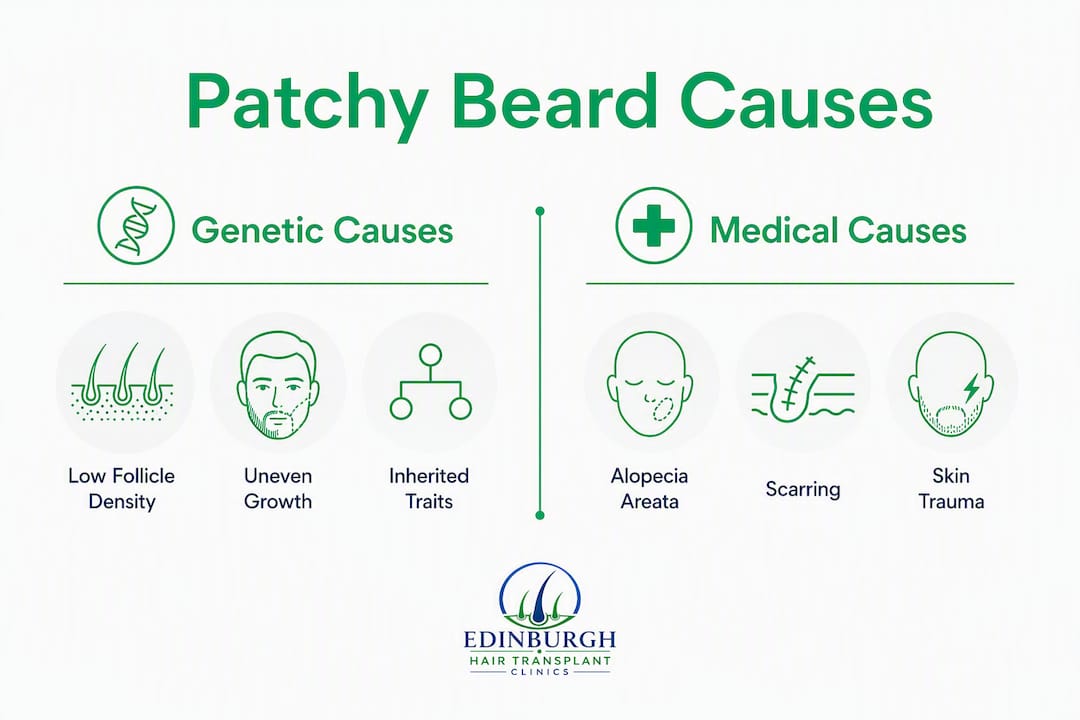
Scarring and trauma destroy follicle units permanently. Burns, surgical incisions, acne scarring and accidents leave areas where hair simply cannot regrow because the follicles are gone. These are often excellent candidates for transplant camouflage, provided the recipient skin has stabilised.
Hormonal factors play a supporting role. Testosterone and its derivative DHT influence beard density, which is why many men see their beard fill in gradually through their twenties. A 22-year-old with patchy cheeks may look quite different at 28 without any intervention.
Skin conditions and grooming damage can mimic permanent patchiness:
- Tinea barbae (a fungal infection of the beard area) causes patchy hair loss that resolves with antifungal treatment.
- Severe cystic acne can damage follicles over time.
- Traction from aggressive grooming or tight face coverings can cause localised thinning.
If your patchiness appeared suddenly, is itchy or inflamed, or coincides with a skin condition, see a GP or dermatologist before considering any hair restoration procedure.
How does a patchy beard transplant actually work?
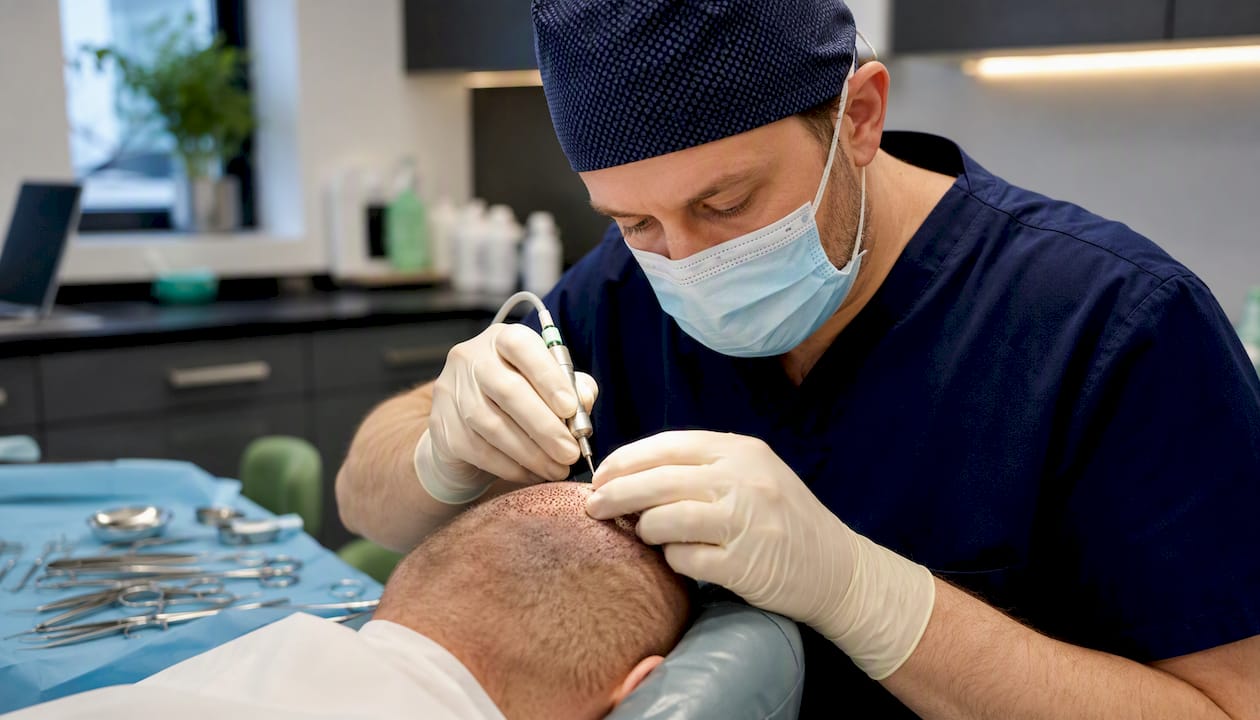
A beard transplant is a donor-to-recipient transfer of living follicular units. Hair follicles are harvested from a donor site, typically the occipital scalp (the back and sides of the head) or the sub-jawline beard area, and implanted into the sparse facial zones. Because the transplanted follicles retain their genetic programming, they continue to grow in their new location long term.
FUE: follicular unit extraction
FUE extracts individual follicular units one by one using a small circular punch, leaving no linear scar. Each unit contains one to four hairs. The harvested grafts are sorted, kept in a preservation solution, and then implanted into recipient sites created in the beard area. FUE is the most common technique for facial hair work because the absence of a linear scar suits patients who wear their hair short.
DHI: direct hair implantation
DHI skips the separate channel-creation step. A specialised implanter pen places each graft directly into the skin in a single motion, which gives the surgeon finer control over the angle, depth and direction of each hair. For beard work, where exit angles need to be very acute to mimic the flat lie of facial hair, this precision matters. DHI can also reduce the time grafts spend outside the body, which may support graft survival.
The surgical detail that determines naturalness
Facial hair exits the skin at very acute angles, often nearly parallel to the surface. Placing grafts at the wrong angle produces hairs that stand upright rather than lying flat, and the result looks artificial regardless of how many grafts were used.
Surgeons use single-hair follicular units along the outer edges of the beard, the cheek border, the moustache line and the sideburns transition, because single hairs create a soft, graduated perimeter. Multi-hair units go into the interior of the beard where density is needed. Research published in PMC confirms this cosmetic density strategy: the goal is visual fullness, not matching the native follicle count exactly.
Donor hair from the scalp retains its scalp characteristics. It tends to grow faster and with a slightly different texture than native facial hair, which means transplanted beard hair often needs more frequent trimming to stay in proportion with the surrounding beard.
| Feature | FUE | DHI |
|---|---|---|
| Harvesting method | Individual punch extraction | Individual punch extraction |
| Implantation | Separate channel creation, then graft placement | Single-step implanter pen |
| Angulation control | Good | Very precise |
| Scarring | Tiny circular dots, no linear scar | Tiny circular dots, no linear scar |
| Typical use for beard | Widely used | Preferred where fine directional control is critical |
| Graft time outside body | Slightly longer | Shorter |
On procedure day, you arrive for local anaesthetic to both the donor and recipient areas, then the harvesting phase begins. Graft preparation runs concurrently. Implantation follows, with the surgeon working methodically across the mapped beard zones. Total chair time for a beard procedure varies with graft count but commonly runs several hours.
What makes a beard transplant look natural?
The difference between a result that looks genuinely grown and one that looks transplanted almost always comes down to design decisions made before the first incision.

Avoid enforced symmetry. Natural beards are not perfectly symmetrical. One side grows slightly denser than the other; the cheek line dips and rises unevenly. Surgical planning experts note that designing a beard with sharp, perfectly mirrored borders looks artificial, particularly as the patient ages and the face changes. Soft transitions and subtle micro-irregularities are what make a result convincing.
Cosmetic density versus biological density. You do not need to match the follicle count of a naturally dense beard. Placing hair strategically at the right angles and in the right zones creates the perception of fullness with fewer grafts than you might expect. This matters practically: it preserves donor supply for any future sessions.
Donor matching. Scalp hair and sub-jawline beard hair behave differently. Scalp hair grows faster and may have a slightly coarser texture. When planning which donor site to use, surgeons weigh texture compatibility against available supply. For patients with limited scalp donor hair, the sub-jawline area can supplement the harvest.
Planning checklist before surgery:
- Grow the beard for an extended period to map true coverage and identify which zones genuinely need grafts.
- Assess donor density and calculate a realistic graft budget.
- Mark transition zones carefully, distinguishing where single-hair units end and multi-hair units begin.
- Set a target density that is achievable in one session, with a clear plan for staged sessions if more coverage is wanted later.
- Photograph the beard from multiple angles in consistent lighting to track progress.
Pro Tip: Reserve your multi-hair follicular units for the interior of the beard only. Placing them at the cheek border or moustache edge creates an unnaturally abrupt line that no amount of trimming will fix.
Are you a good candidate for a beard transplant?
Most men with patchy facial hair are not automatically suitable for surgery. Candidacy depends on several converging factors.
Positive signs you may be a good candidate:
- Your patchiness is stable and has not changed significantly over the past year.
- The cause is genetic, scarring, or post-traumatic follicle loss rather than an active inflammatory condition.
- Your donor area (occipital scalp or sub-jawline) has adequate density for the graft count your beard design requires.
- You want a permanent solution and have realistic expectations about achievable density.
- You have allowed a sufficient period of growth and can clearly see which areas are genuinely sparse.
Red flags that suggest surgery should wait:
- Active tinea barbae, inflamed alopecia areata, severe psoriasis or any uncontrolled skin condition in the beard area. ISHRS guidance is explicit: these must be diagnosed and stabilised by a dermatologist before transplantation is considered.
- Insufficient donor hair to meet the graft requirements of your planned beard design.
- Expectations that a single session will produce the density of a naturally thick beard when donor supply is limited.
- You are under 25 and your beard is still maturing hormonally.
Transgender and reconstructive indications. Beard transplantation is a recognised part of facial masculinisation for transgender men, and Edinburgh Hair Transplant Clinics offers specialist transgender hair restoration that includes beard construction. Scar camouflage after burns, surgery or trauma is another strong indication, provided the recipient skin has fully stabilised.
The 90–120 day growth period is not just a formality. It is the only reliable way to distinguish genuinely absent follicles from follicles that are present but producing fine, slow-growing hair. Mapping a beard too early leads to over-treatment and wasted grafts.
What to expect: procedure day through to 12 months
Recovery from a beard transplant follows a predictable arc, though the pace varies between patients.
| Phase | Timeframe | What happens |
|---|---|---|
| Procedure day | — | Local anaesthetic, graft harvest, implantation, immediate aftercare instructions |
| Early healing | — | Scabbing around graft sites, mild swelling, scabs fall off by week 2 |
| Shock loss | Weeks 2–6 | Most transplanted hairs shed — this is normal and expected |
| Early regrowth | Months 3–4 | New hairs begin emerging from transplanted follicles |
| Thickening | Months 4–6 | Hairs gradually coarsen and darken; coverage becomes visible |
| Maturation | Months 6–12 | Density continues to improve; final cosmetic result often settles around month 12 |
Shock loss: what it is and why it happens
The early shedding phase — sometimes called shock loss — alarms many patients. Transplanted hairs shed during the first few weeks as the follicles enter a resting phase before beginning a new growth cycle. This phased recovery is a normal part of the process; the follicle itself remains alive beneath the skin. Edinburgh Hair Transplant Clinics has a dedicated resource on shedding and shock loss that explains what to expect week by week.
Aftercare essentials
The first two weeks are the most critical for graft survival:
- Follow the clinic’s washing protocol precisely — typically a gentle saline spray in the first days, progressing to careful shampooing once scabs have formed.
- Sleep with your head slightly elevated to reduce swelling.
- Avoid direct sunlight on the recipient area for at least four weeks.
- No strenuous exercise for two weeks; raised blood pressure increases the risk of graft displacement in the early healing window.
- Do not shave or trim the transplanted area until the clinic confirms it is safe, usually after the first month.
For a detailed month-by-month breakdown, the hair transplant timeline at Edinburgh Hair Transplant Clinics maps each recovery phase clearly.
What do realistic results actually look like?
A well-executed beard transplant produces hair that looks grown, not planted. The key word is realistic : the result depends on donor supply, skin quality, angulation, and how the beard is designed.
What “natural” means in practice:
- Soft cheek borders that graduate from sparse to dense rather than cutting off sharply.
- Varied exit angles across the beard that mimic the natural directional flow of facial hair.
- Cosmetic density that reads as full in normal lighting, even if the follicle count is lower than a naturally thick beard.
- A moustache line and goatee border that have slight irregularity rather than a ruler-straight edge.
Factors that influence the final outcome:
- Donor hair texture: scalp hair that closely matches native facial hair in calibre produces a more seamless result.
- Patient age and skin laxity: younger skin tends to heal with less visible scarring at donor sites.
- Angulation accuracy: this is the single biggest technical variable. Wrong angles are difficult to correct.
- Staged sessions: some patients need two sessions to reach their target density, particularly when the area to fill is large or donor supply is limited.
Reading before-and-after images critically. Before-and-after galleries are useful, but look for consistent lighting, similar facial expressions, and images taken at comparable beard lengths. A result photographed at three weeks of growth looks very different from the same result at twelve months. The before-and-after gallery at Edinburgh Hair Transplant Clinics shows patient cases across different beard zones and growth stages.
After the transplant, transplanted scalp hair may grow faster than surrounding facial hair and need more frequent trimming. Most patients find a consistent trimming routine settles into habit within a few months.
What are the risks and how often do results fall short?
A beard transplant is a surgical procedure, and like any surgery it carries risks. Understanding them helps you ask better questions at your consultation.
Common minor issues:
- Scabbing and crusting around graft sites in the first two weeks.
- Temporary numbness or altered sensation in the donor or recipient area.
- Mild swelling, particularly around the eyes if the moustache area was treated.
- Folliculitis (small pimples around transplanted hairs) during the first months of regrowth, usually resolving without treatment.
More significant failure modes:
- Poor angulation producing hairs that grow at the wrong angle, creating an unnatural appearance that is difficult to correct without revision surgery.
- Graft non-take, where implanted follicles fail to survive the transfer, leaving the treated area no denser than before.
- Over-harvesting the donor area, which leaves visible thinning at the back of the scalp and limits options for future sessions.
- Cosmetic dissatisfaction when expectations were not aligned with what the donor supply could realistically deliver.
Graft survival rates vary by technique, surgeon experience and patient factors. Ask your clinic directly what survival rates they achieve and how they define a successful outcome. ISHRS guidance underlines that donor hair is finite, which shapes what is achievable in any single session.
Reducing your risk:
- Choose a surgeon with documented experience in facial hair transplantation specifically, not just scalp work.
- Insist on photographic planning before surgery so the design is agreed and recorded.
- If donor supply is limited, plan staged sessions rather than attempting maximum density in one go.
- Confirm that the clinic screens for active dermatological conditions before proceeding.
Non-surgical options to try before or alongside surgery
Surgery is not the only route to a fuller beard, and for some men it is not the right first step at all.
Topical minoxidil is the most widely used non-surgical option for improving beard density. Originally developed for scalp hair loss, minoxidil applied to the face has shown anecdotal benefit in stimulating finer vellus hairs to thicken and darken. It is not licensed for facial use in the UK, so medical advice is needed before starting. Results require consistent daily application and typically take several months to assess. Stopping minoxidil usually reverses any gains.
PRP (platelet-rich plasma) involves drawing a small amount of blood, concentrating the growth-factor-rich plasma, and injecting it into the beard area to stimulate follicle activity. Evidence for PRP as a standalone beard treatment is still developing, but it is used as an adjunct to transplantation at some clinics to support graft survival and accelerate healing. For follicle stimulation approaches more broadly, this practical guide to hair follicle stimulation covers the underlying mechanisms.
Lifestyle and nutritional measures have a supporting role rather than a primary one. Adequate sleep, a diet sufficient in zinc, iron and protein, and managing chronic stress all contribute to the conditions in which hair grows well. Biotin supplementation is often cited, but the evidence for it improving beard growth in men who are not deficient is thin. If blood tests show a deficiency, correcting it makes sense; supplementing without a deficiency is unlikely to produce visible results.
Cosmetic camouflage offers immediate improvement without any downtime:
- Beard filler pens and fibres shade sparse areas and can make a patchy beard look significantly fuller for a day.
- A skilled barber can shape the beard to work with your natural growth pattern, making patches less obvious.
- Growing the beard for 90–120 days and then having it professionally shaped is often the most underrated step men skip.
When to prefer non-surgical routes first:
- You are under 25 and your beard may still be maturing.
- An active medical cause (alopecia areata, tinea barbae) needs treating first.
- Your donor supply is limited and surgery would not deliver the density you want.
- You want to trial minoxidil or PRP for six months before committing to a procedure.
When non-surgical options have been tried and the patchiness remains, or when the cause is scarring or genetic and no topical treatment will change the follicle count, surgical planning becomes the logical next step.
How many grafts do you need and what does it cost in the UK?
Graft count drives cost, and both vary considerably depending on what you are trying to achieve.
| Beard zone / goal | Approximate graft range | Notes |
|---|---|---|
| Small scar camouflage | — | Localised area; single session usually sufficient |
| Cheek patch fill (one side) | — | Depends on patch size and desired density |
| Full cheek coverage (both sides) | — | Larger area; donor supply must be assessed |
| Full beard construction | — | Includes cheeks, jawline, moustache and goatee |
| Moustache or goatee only | — | Precise angulation critical in this zone |
These are ballpark figures. Your actual graft requirement depends on the size of the area, the density you want, your existing hair, and the surgeon’s assessment of your donor supply.
UK pricing factors. Beard transplant costs in the UK vary with graft count, technique (FUE or DHI), clinic credentials, and whether adjuncts such as PRP or sedation are included. Consumer-facing sources report wide international price variation, with figures ranging from approximately $3,000 to over $15,000 depending on scope. UK pricing sits within a comparable range in sterling, but the only reliable figure is a bespoke quote from a clinic that has assessed your donor area and agreed a graft plan.
For a transparent starting point on UK pricing, the cost guide at Edinburgh Hair Transplant Clinics sets out what factors influence the final price.
Pricing caveats to keep in mind:
- Ask for an itemised quote that separates the graft fee, anaesthetic, aftercare appointments and any revision policy.
- Confirm whether the quoted graft count is guaranteed or an estimate subject to change on the day.
- Understand what a revision session would cost if the first result does not meet the agreed design.
- Be cautious of very low prices that do not specify graft counts or surgeon credentials.
How to choose a clinic and what to ask at your consultation
The quality of your result depends more on the surgeon and clinic than on the technique name. FUE and DHI are both well-established; the difference is in who performs them and how the procedure is planned.
Clinic selection checklist:
- Surgeon credentials: look for membership of the ISHRS or equivalent professional body, and specific experience in facial hair transplantation.
- Before-and-after gallery: the clinic should show real patient results across a range of beard zones and growth stages, not just the best-case outcomes.
- Consultation-led planning: a reputable clinic will not quote a graft count or price without first assessing your donor area and beard in person or via a detailed remote assessment.
- Aftercare provision: confirm what follow-up appointments are included and what the process is if you have concerns during recovery.
- Accreditation and facility standards: the clinic should operate in a regulated environment with appropriate medical oversight.
Essential questions to bring to your consultation:
- How many grafts do you estimate I need, and how did you arrive at that figure?
- What is my donor density, and is it sufficient for the design we have discussed?
- What graft survival rate do you typically achieve for beard procedures?
- What does the healing timeline look like for my specific case?
- What is your revision policy if the result does not match the agreed design?
- What is the total cost, itemised, including aftercare and any follow-up sessions?
- Can I see long-term follow-up images (12 months or beyond) from previous beard patients?
Red flags to watch for:
- A clinic that quotes a graft count and price before examining your donor area.
- Pressure to sign a treatment agreement at the first appointment.
- No photographic documentation of the planned design before surgery.
- Vague or absent aftercare instructions.
- Guaranteed density figures without any caveat about donor limitations.
Reading before-and-after photos takes practice. Look for images taken at the same beard length, in consistent lighting, from the same angles. Ask specifically for photos taken at six and twelve months, not just at four to six weeks when early regrowth looks dramatic but the final result is not yet visible.
Edinburgh Hair Transplant Clinics: consultation-led beard restoration in Edinburgh
If you have reached the point where you know a patchy beard is not going to fill itself, Edinburgh Hair Transplant Clinics offers something that matters most at this stage: a proper assessment before any commitment to surgery.
The clinic’s beard transplant service is built around consultation-led planning. That means your donor area, hair-loss pattern, medical history and realistic graft requirements are all assessed before a treatment plan is drawn up. FUE and DHI facial hair techniques are both available, and the design process prioritises natural-looking results with soft borders and appropriate angulation rather than a one-size approach.
For patients with scar-related patchiness, the clinic also offers scar camouflage transplantation, and for transgender men seeking beard construction as part of masculinisation, specialist services are available. Aftercare is built into the process, not an afterthought.
To see what results look like across different beard zones and patient profiles, the before-and-after gallery is the most direct evidence. When you are ready for a personalised graft estimate and design discussion, request a quote to start the process.
Key takeaways
A beard transplant is an effective, often permanent solution for patchy facial hair caused by genetics, scarring or trauma, but candidacy, donor supply and realistic expectations determine whether surgery is the right path.
| Point | Details |
|---|---|
| When a transplant is appropriate | Stable, genetic or scar-related patchiness with adequate donor supply is the strongest indication for surgery. |
| Allow 90–120 days of growth first | Growing the beard fully before assessment reveals true coverage and prevents over-treatment with unnecessary grafts. |
| Top consultation questions | Ask about graft count rationale, donor density, survival rates, revision policy and itemised total cost. |
| Non-surgical options first | Minoxidil, PRP and cosmetic camouflage are worth trialling, especially for younger men or those with active medical causes. |
| Edinburgh Hair Transplant Clinics | Offers consultation-led FUE and DHI beard restoration in Edinburgh, with bespoke design and donor assessment before any treatment plan is agreed. |
A note on what patients actually ask
The questions that come up most often in beard transplant consultations are rarely about the surgery itself. They are about what happens afterwards.
The trimming question is almost universal: can you shave or trim after a transplant? The answer is yes, but not immediately. Most clinics advise waiting until the grafts are fully settled, typically around four to six weeks, before any blade touches the area. After that, transplanted hair behaves like any other hair and can be trimmed, shaped and styled normally. Because scalp donor hair tends to grow faster than native facial hair, many patients find they trim the transplanted sections slightly more often than the rest of the beard.
Staged sessions come up frequently too. A single session is sufficient for many patients, particularly those filling a defined patch or camouflaging a scar. For men wanting a full beard construction from minimal existing coverage, two sessions spaced several months apart often produce a better result than attempting maximum density in one go. The donor area needs time to recover between harvests, and a staged approach also lets the surgeon assess how the first session has settled before planning the second.
PRP as an adjunct is another common topic. Some patients ask whether combining PRP with their transplant will improve graft survival. The evidence is still developing, but several clinics use PRP at the time of implantation as a supportive measure. It is worth asking your clinic directly whether they offer it and what their rationale is.
One practical piece of advice: bring photographs to your consultation. A record of how your beard has grown over the past 90–120 days, photographed consistently in the same lighting and from the same angles, gives the surgeon far more useful information than a verbal description. It also makes the design conversation more concrete.
Further reading and sources
- ISHRS: Beard and moustache transplant overview — technical background on indications, techniques and candidacy from the International Society of Hair Restoration Surgery.
- PMC: Hair transplant technique and outcomes — peer-reviewed detail on cosmetic density strategy, follicular unit selection and angulation principles.
- PMC: Hair restoration clinical review — broader clinical context on hair restoration outcomes.
- NHS: Psoriasis symptoms — reference for skin conditions that may affect candidacy.
- Hair restoration treatment timeline explained — partner guide covering recovery phases and aftercare context.
- Edinburgh Hair Transplant Clinics: beard transplant service — clinic-specific information on FUE facial hair procedures and consultation process.
- Edinburgh Hair Transplant Clinics: before-and-after gallery — patient case images across beard zones and growth stages.
- Edinburgh Hair Transplant Clinics: hair transplant timeline — month-by-month recovery guide for patients.
Recommended
- Beard Transplant Edinburgh | FUE Facial Hair
- Hair Transplant Timeline Edinburgh | Month by Month
- Hair Transplant Edinburgh in 2026: Cost, Techniques, Recovery and How to Choose a Clinic
- Hair Transplant Blog Edinburgh | Expert Guides
Dr Harpreet Kalra
Hair transplant surgeon and practising GP · GMC 7126076
About Dr KalraQuestions and answers
Is filling a small beard patch the same as creating a full beard?
The area to cover and the existing beard hair change the plan. The surgeon needs to assess the donor supply, proposed density and how new growth would blend with the surrounding hair.
Should I bring photographs of the beard shape I want?
Yes. They can help explain whether you want to address patches, the cheek line or a larger area. The surgeon should explain which aspects are realistic for your own hair and facial features.
When can I shave the transplanted area?
Ask your treating team for an individual schedule. The timing depends on healing and the type of shaving or trimming you plan to do; avoid applying a general online date to a healing area.