
The Norwood scale: understanding male pattern hair loss
A stage can describe the pattern of hair loss. It cannot, by itself, tell you how quickly it will change or how many grafts you need.

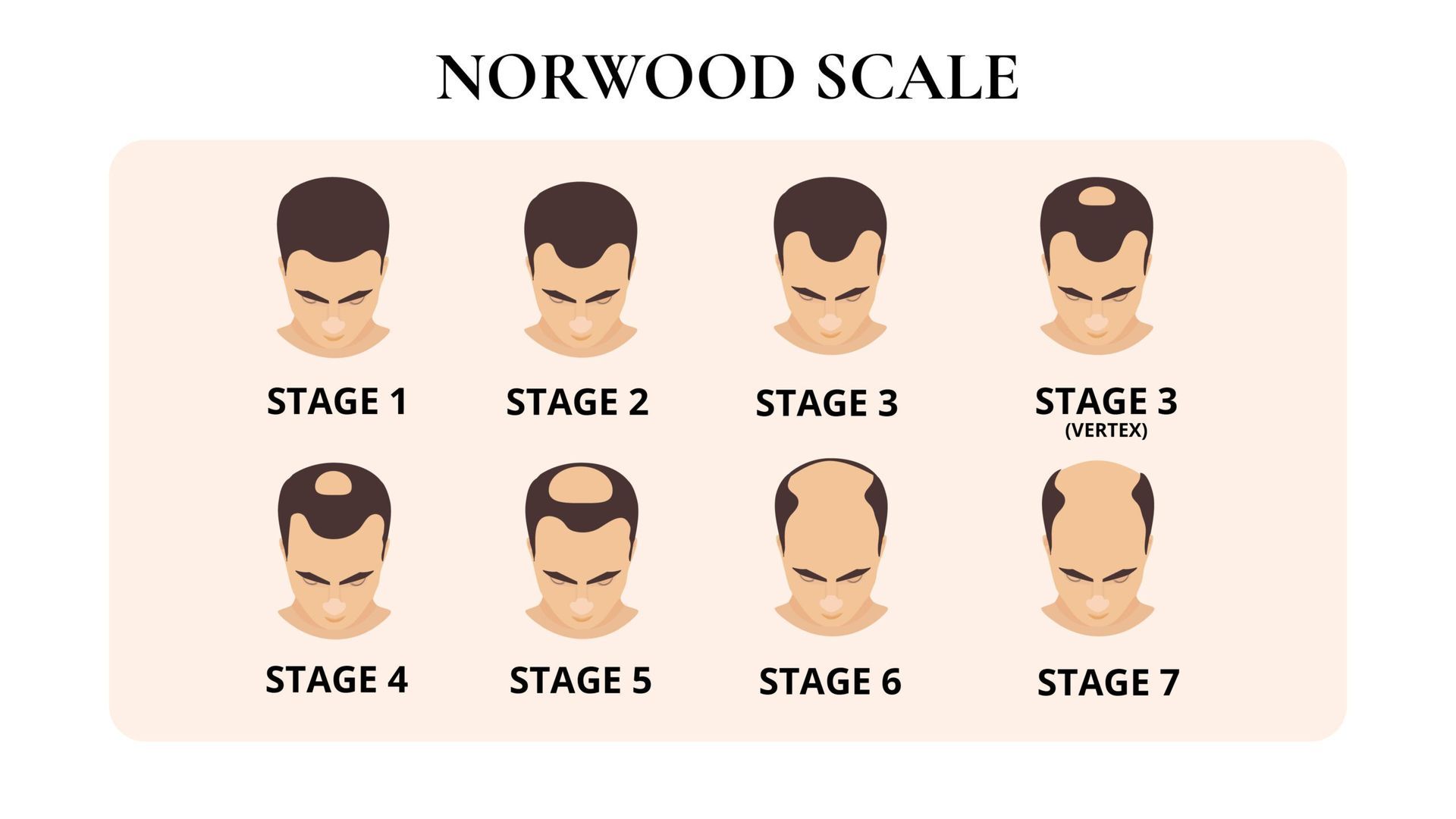
What the Norwood scale measures
The Hamilton–Norwood scale is a way of describing common patterns of male hair loss. It looks at recession around the temples and front, thinning over the crown and how those areas join as loss becomes more extensive. It helps make a discussion or photographic record more consistent.
It is not a diagnosis and it does not capture every pattern. Diffuse thinning, inflammation, sudden shedding and patchy hair loss need an assessment rather than simply a stage number. Our male pattern baldness guide explains the underlying condition.
Norwood stages 1–7
Use these descriptions as a guide to the shape of loss, not a prediction of what must happen next.
- Stage 1
- Little or no noticeable recession at the front and temples.
- Stage 2
- Mild recession at the temples, often creating a slightly more pronounced M-shaped hairline.
- Stage 3
- Deeper temple recession. In the stage 3 vertex pattern, thinning is also apparent at the crown.
- Stage 4
- More marked frontal recession and crown loss, with a band of hair still separating the two areas.
- Stage 5
- The front and crown areas are larger and the band between them is narrower or less dense.
- Stage 6
- The separating band has largely disappeared, joining the frontal and crown areas.
- Stage 7
- The most extensive pattern in the scale, with a remaining band of hair around the sides and back.
Some men have a type A pattern, where the hairline moves backwards without the same separate crown pattern. Real hair loss does not always fit a textbook drawing exactly.
How to make photographs useful
Take pictures from the front, both temples, above and the crown. Keep the lighting, camera angle, distance and hair length as similar as you can. Wet hair, a fresh haircut or strong overhead light can make the same scalp look very different.
Compare photographs taken months apart, rather than repeatedly checking day to day. Record when shedding or recession first became noticeable and whether there have been changes in health, medication or weight. These details can be more useful at a consultation than a self-assigned stage.
What a Norwood number cannot tell you
The scale does not measure donor density, the thickness of individual hairs or how much the appearance bothers you. It also does not reliably predict the final pattern. A family history is useful context, but it is not a timetable for your own hair loss.
DermNet's explanation of male pattern hair loss describes the inherited tendency and gradual miniaturisation involved. Thinning may coexist with other causes of shedding, so a change in appearance deserves a proper history and examination.
How it helps with treatment planning
Treatment starts with establishing the cause and discussing your priorities. Medical treatment may be considered for pattern hair loss; benefits, adverse effects and the need for continued use should be discussed with an appropriate clinician. Surgery is one possible option, not an automatic consequence of reaching a particular stage.
There is no reliable conversion from a Norwood stage to a graft number. The size of the area, desired hairline, existing hair and available donor supply all matter. Our donor area guide explains why preserving that supply is central to planning.
For more extensive loss, a realistic plan may favour the front and leave lighter coverage elsewhere. For early recession, the question may be whether to monitor or treat the underlying loss before considering surgery. A low hairline chosen now can be difficult to support if loss progresses.
When to arrange an assessment
Arrange an assessment if you are uncertain about the cause, if the pattern is changing or if you want to compare treatment options. The NHS advises speaking to a GP about hair loss before attending a commercial clinic. Sudden patches, scalp symptoms or rapid diffuse shedding should not be assumed to be ordinary male pattern loss.
For an Edinburgh consultation, bring your photographs, medication list and details of any previous treatment. Our locations page distinguishes consultation rooms from the sites used for surgery.
Questions and answers
Does stage 2 mean I need a transplant?
No. A mildly receded hairline alone does not establish a need for surgery. Your age, pattern over time, examination and preferences all inform the discussion.
Will everyone reach stage 7?
No. The scale describes patterns of increasing extent; it does not mean that every person passes through all seven stages.
Can the scale be used for women?
It is mainly used for male pattern hair loss. Women commonly have different patterns, and clinicians may use other scales alongside the examination.
Can I diagnose my stage from a selfie?
A selfie may show the front but miss the crown and diffuse thinning. Consistent photographs from several angles can support, but cannot replace, clinical assessment.
